


Line Marking Service California
Professional line marking services throughout Southern California — parking lot striping, warehouse floor marking, ADA compliance, fire lane marking, athletic court marking, and pavement markings for all commercial, industrial, and municipal surfaces. Veteran-owned. Free estimates.
Bowman Line Striping Inc · CA Contractor License #1138257 · BBB Accredited · Veteran-Owned

Line Marking Service California — Quick Answer
What Is Line Marking Service and How Much Does It Cost in California?
Line marking service applies durable painted or thermoplastic markings to parking lots, warehouse floors, athletic courts, and roadways to organize traffic, designate areas, and meet compliance requirements. In California, line marking costs $0.40–$1.00 per linear foot for parking lot striping, $0.08–$0.20 per sq ft for warehouse floor marking, and $2–$7 per linear foot for fire lane red curbing. Most commercial lots need re-marking every 18–24 months. Call (760) 454-1606 for a same-day free estimate.
Line marking service goes by many names — line striping, pavement marking, lot painting, floor marking, parking lot striping. Whatever you call it, the function is the same: applying durable visible markings to organize space, control movement, communicate safety information, and meet compliance requirements. We serve every line marking application throughout Southern California from our Ridgecrest and Van Nuys offices.
Line Marking Service Types — What Do You Need?
Line marking covers a wide range of applications. Select the type that matches your property to go directly to the relevant information.
Parking Lot Line Marking
Parking space boundaries, traffic lanes, directional arrows, stop bars, crosswalks. The most common line marking service. Standard 9×18-foot spaces, 4-inch line width.
Parking lot striping services →ADA Accessible Marking
ISA wheelchair symbols, access aisle diagonal striping, van-accessible designation, blue paint. California CBC Title 24 compliant. $4,000 minimum fine per violation.
ADA compliance services →Fire Lane Marking
Red curb painting, “NO PARKING FIRE LANE” stenciling, prohibition signs. California Fire Code § 503. Emergency same-day response for active citations.
Fire lane services →Warehouse Floor Marking
Forklift traffic lanes, pedestrian walkways, hazard zones, loading dock markings. OSHA color-coded systems. Epoxy and MMA formulations for heavy industrial traffic.
Industrial striping →Athletic Court Marking
Basketball, tennis, pickleball, volleyball court lines. Multi-sport overlay layouts. Schools, parks, HOA recreation areas. Specialized sport-surface paints.
Athletic marking →Roadway & Municipal Marking
Centerlines, edge lines, crosswalks, turn arrows, bicycle lanes, school zone markings. MUTCD compliant. Public works and municipal contracts.
Municipal striping →Pavement Markings
Arrows, stencils, symbols, numbers, custom logos, speed bumps, curb painting. Any marking that goes on asphalt or concrete. Unlimited customization.
Pavement markings →EV Charging Bay Marking
EV CHARGING ONLY stenciling, space boundaries, accessible EV designations. California CALGreen Title 24 compliant. Growing requirement for new construction and renovations.
EV charging marking →Line Marking Service Cost California 2026
Pricing varies significantly by surface type, marking complexity, paint material, and location within California. Southern California coastal markets command premium rates. Inland and High Desert markets are more competitive. All prices below reflect Southern California standard market rates.
| Service Type | Unit | Low | High | Notes |
|---|---|---|---|---|
| Parking lot line striping | Per linear ft | $0.40 | $1.00 | Standard 4-inch acrylic paint — inland to Westside range |
| Parking lot re-stripe — small lot | Per project | $300 | $950 | Under 50 spaces, over existing visible lines |
| Parking lot re-stripe — mid lot | Per project | $500 | $1,500 | 50–100 spaces |
| Warehouse floor marking | Per sq ft | $0.08 | $0.20 | Standard acrylic — epoxy adds 50–100% |
| Warehouse epoxy floor marking | Per sq ft | $0.18 | $0.45 | 2-part epoxy for forklift traffic — 3–5 yr lifespan |
| ADA handicap space — full marking | Per space | $50 | $175 | ISA symbol, access aisle, boundary lines |
| Fire lane red curb + stenciling | Per linear ft | $3.50 | $7.00 | CFC § 503 compliant |
| Directional arrows | Each | $20 | $55 | Standard MUTCD arrow stencil |
| Custom stencil marking | Each | $35 | $200 | STOP, RESERVED, numbers, logos, custom text |
| Thermoplastic line marking | Per linear ft | $3.00 | $8.00 | 5–7 yr lifespan — best long-term value for high-traffic |
| Athletic court marking | Per court | $200 | $800 | Basketball, tennis, pickleball — standard layouts |
| EV charging space marking | Per space | $45 | $120 | CALGreen Title 24 compliant |
Get an instant estimate for your parking lot broken down by lot size, paint type, pavement condition, and add-on services. Open the 2026 cost calculator →
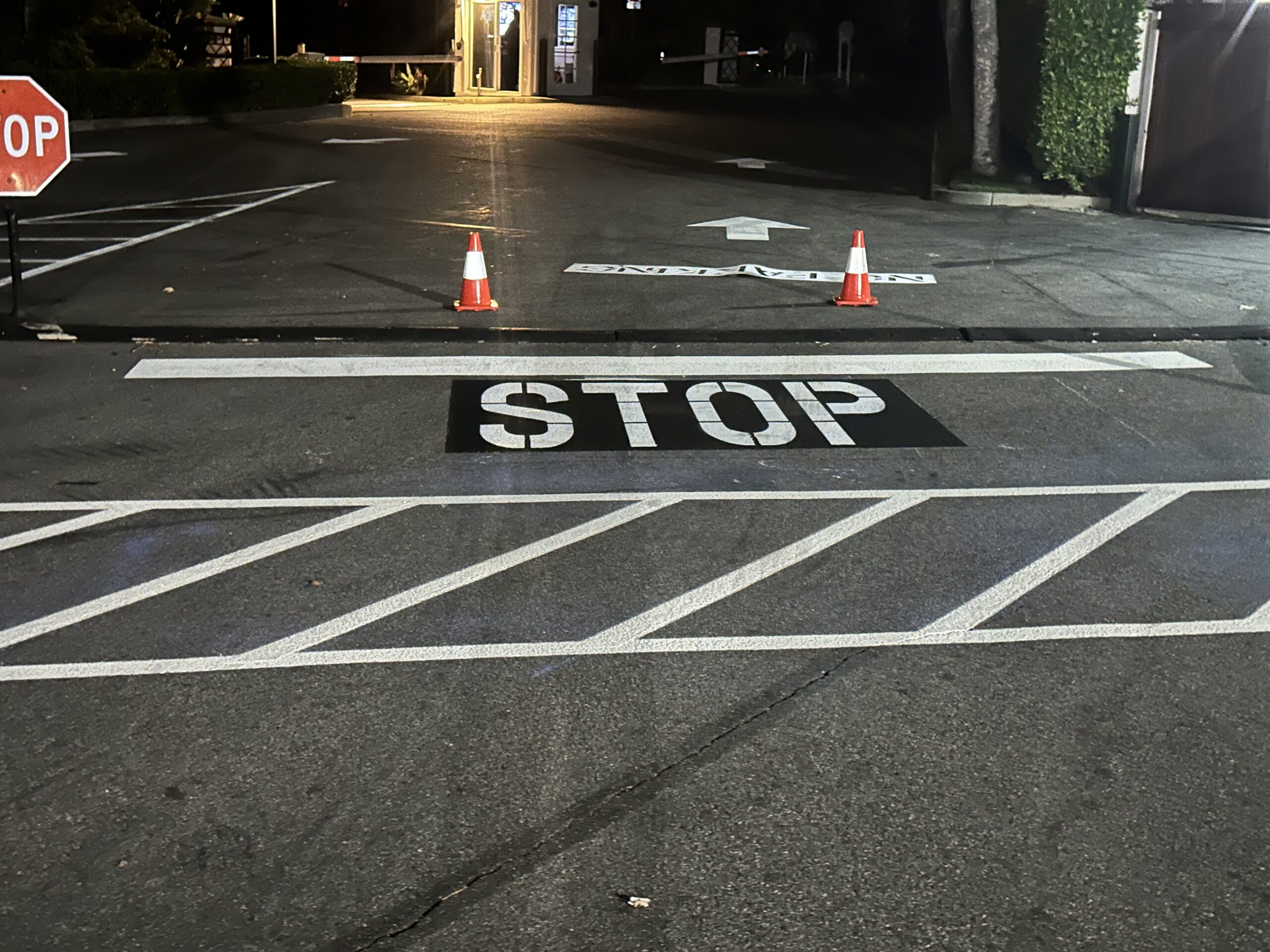
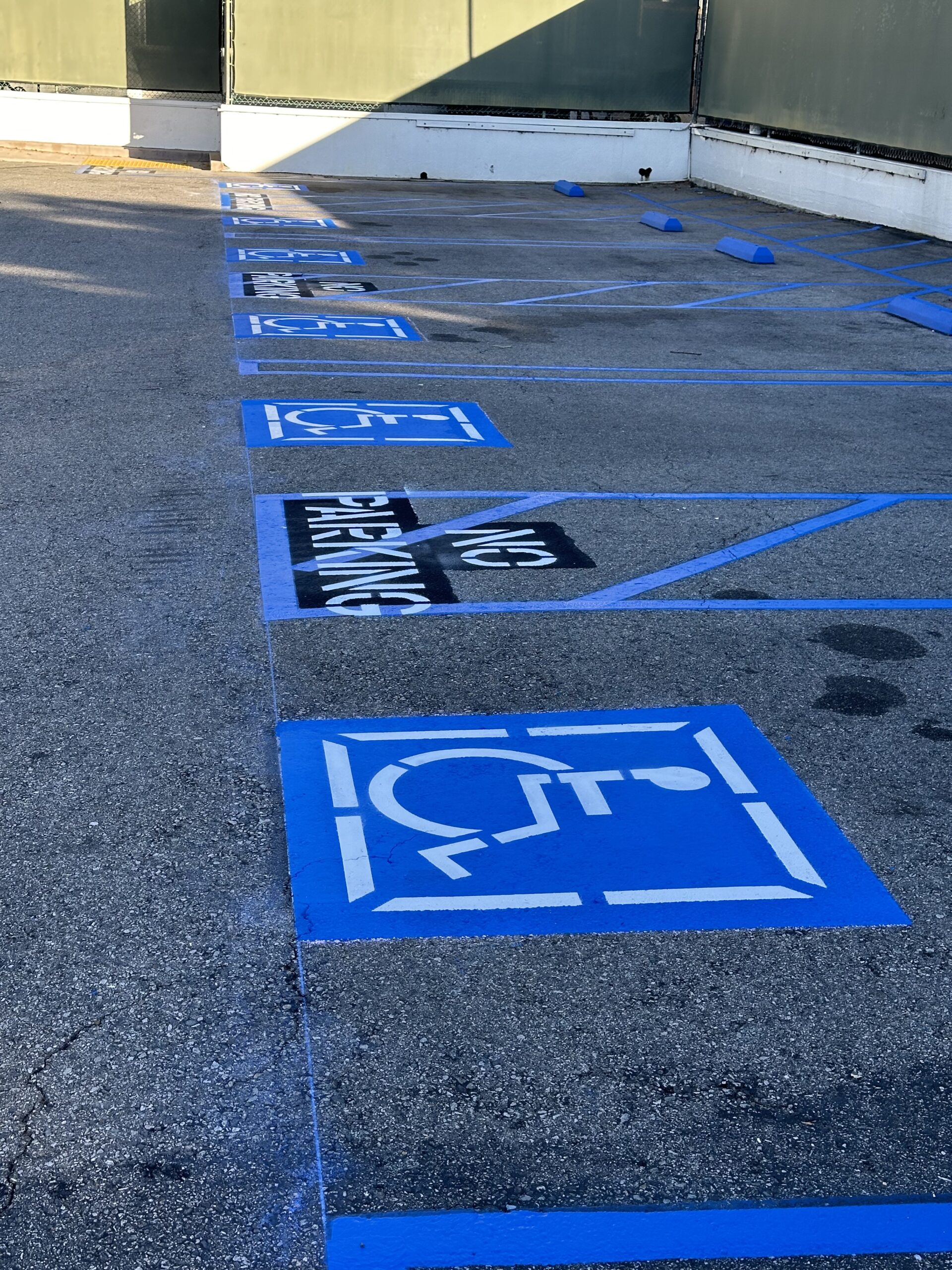
Completed line marking and parking lot striping projects — Southern California · Bowman Line Striping Inc · CA License #1138257
Line Marking Materials — Which One Is Right?
Material selection is the single biggest factor in how long your line marking lasts and what it costs over a 5-year period. The cheapest material per application is rarely the cheapest per year of performance.
| Material | Cost Per Ft | Lifespan SoCal | Best For | Limitations |
|---|---|---|---|---|
| Water-based acrylic | $0.40–$0.60 | 12–18 months | Standard parking lots, budget projects, frequent re-stripe schedules | Fades fastest in SoCal UV — not recommended for High Desert |
| Premium UV-resistant acrylic | $0.55–$0.85 | 18–30 months | Most Southern California commercial properties — best value overall | Higher upfront cost than standard but lower 5-year total cost |
| Thermoplastic | $3–$8 | 5–7 years | High-traffic entries, ADA symbols, crosswalks, fire lanes — marks that must last | High upfront cost — not economical for entire parking lots |
| Epoxy (2-part) | $0.80–$1.50 | 3–5 years | Warehouse floors, loading docks, industrial surfaces under heavy forklift traffic | Requires professional surface prep — cannot be applied over dirty or weak concrete |
| MMA (methyl methacrylate) | $1.20–$2.00 | 5–8 years | Maximum-durability warehouse floors, cold-storage facilities, high-abuse industrial | Highest material cost — justified only for high-traffic industrial applications |
OSHA Warehouse Floor Marking Color Code
OSHA 29 CFR 1910.22 and industry standards establish color conventions for warehouse floor marking. While OSHA does not mandate specific colors for all applications, these conventions are universally recognized and should be followed for any OSHA-inspected facility.
Yellow
Forklift traffic lanes, main aisles, caution areas, physical hazards, trip hazards, equipment boundaries
White
Work cell boundaries, production areas, finished goods storage, general pedestrian walkways, inventory areas
Red
Fire equipment locations, fire extinguisher outlines, sprinkler access areas, restricted emergency zones
Blue
Informational areas, raw materials storage, work-in-progress staging, non-hazardous informational zones
Green
Safety equipment locations, first aid stations, safety showers, emergency eyewash stations
Orange
Energized equipment warnings, electrical hazards, machinery guards, power tool use areas
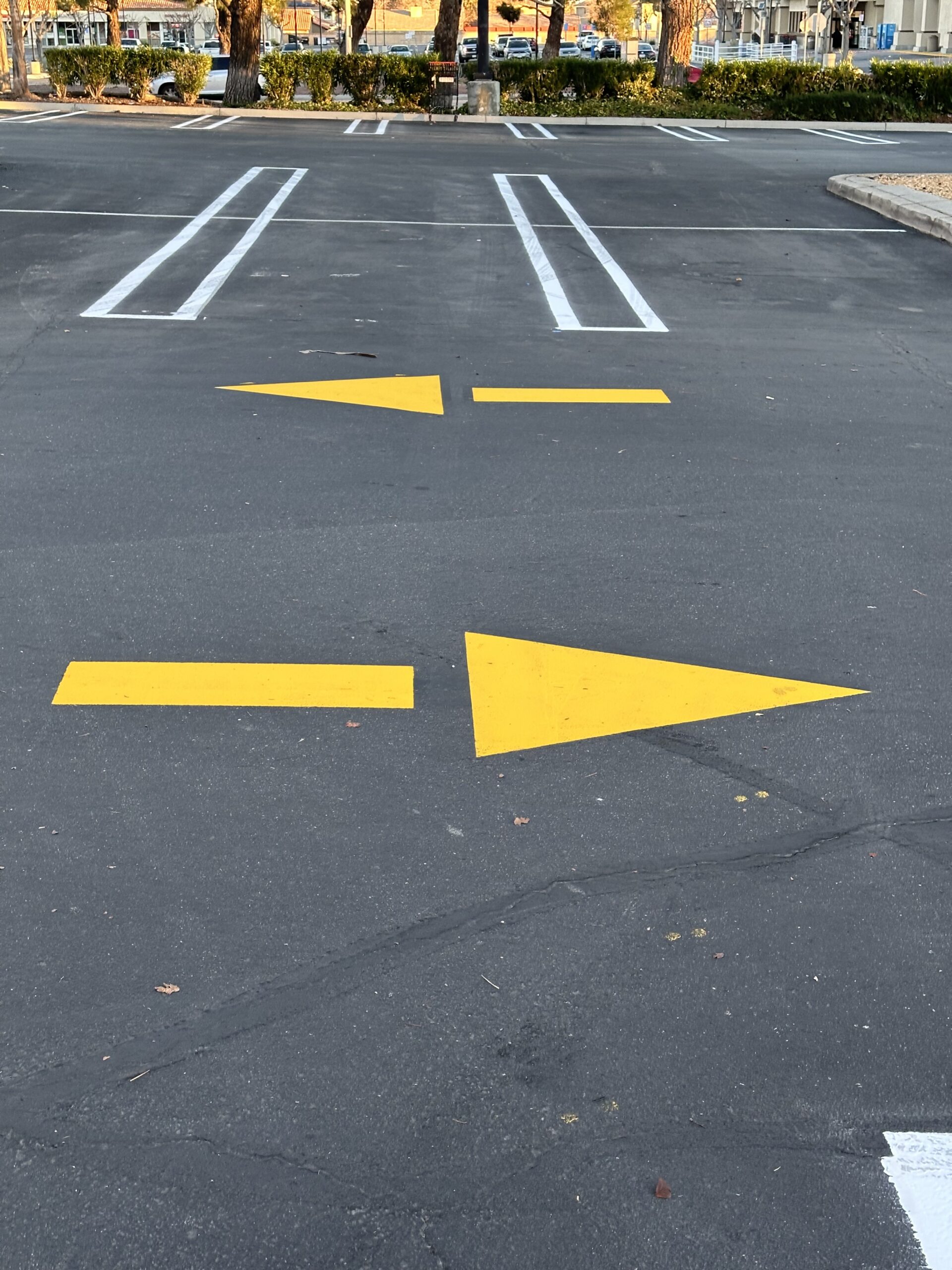
Professional line marking service — Southern California · Bowman Line Striping Inc · CA License #1138257
Line Marking Service FAQ — California 2026
Line marking service is the professional application of durable painted or thermoplastic markings to parking lots, warehouse floors, roadways, athletic courts, and other surfaces. It is also called line striping, pavement marking, lot painting, or parking lot striping depending on the surface and application. Line marking serves four core purposes: organizing space by defining parking areas, storage zones, and work areas; controlling traffic flow through lanes, arrows, and stop bars; communicating safety information via hazard markings, pedestrian zones, and fire lanes; and meeting compliance requirements for ADA accessibility, fire codes, and OSHA workplace safety standards.
Line marking costs in California depend on the surface type and marking complexity. Parking lot line striping costs $0.40–$1.00 per linear foot or $300–$1,500 per project for most small to mid lots. Warehouse floor marking runs $0.08–$0.20 per square foot for standard acrylic or $0.18–$0.45 for epoxy. ADA handicap spaces cost $50–$175 each. Fire lane red curb runs $3.50–$7.00 per linear foot. Thermoplastic costs $3–$8 per linear foot but lasts 5–7 years. Southern California coastal markets — Santa Monica, Beverly Hills — command 15–25% above inland rates. Call (760) 454-1606 for a free written estimate.
Standard water-based acrylic line marking lasts 12–18 months in Southern California before requiring re-application. Premium UV-resistant acrylic extends to 18–30 months. Thermoplastic markings last 5–7 years under normal traffic conditions. Epoxy warehouse floor markings last 3–5 years under forklift traffic. California’s intense UV radiation and high temperatures degrade paint faster than most US markets — inland valley and High Desert properties see the shortest intervals, coastal properties the longest. High-traffic parking lots near retail entrances and drive-through lanes degrade 30–50% faster than low-traffic areas of the same lot.
Line marking and line striping refer to the same service — applying painted markings to parking lots, floors, and other surfaces. The terms are used interchangeably throughout the industry. Line striping is more commonly used in the US for parking lot work. Line marking is slightly broader and is often used for warehouse floor marking, athletic courts, and roadway applications in addition to parking lots. Pavement marking and parking lot painting also describe the same service. At Bowman Line Striping Inc we handle all of these applications — parking lots, warehouses, courts, fire lanes, ADA markings — under one contractor.
The most common paint for parking lot line marking in California is water-based acrylic traffic paint — fast drying, low VOC, and compatible with AQMD Rule 1113 requirements in the South Coast Air Basin. For longer lifespan, premium UV-resistant acrylic formulations with higher solids content and UV stabilizer additives are recommended — especially for inland valley and High Desert properties where standard paint degrades within 8–12 months. Thermoplastic is a non-paint alternative melted onto the pavement at 400°F+ providing 5–7 year lifespan — the best long-term value for high-traffic markings. For warehouse concrete floors, 2-part epoxy or MMA formulations are required — standard traffic paint fails rapidly on concrete under forklift traffic.
OSHA 29 CFR 1910.22 requires that permanent aisles and passageways be clearly marked but does not mandate specific colors. However the following color conventions are universally adopted in US warehouses and are expected by OSHA inspectors: Yellow — forklift traffic lanes, physical hazards, caution areas. White — work cells, production areas, pedestrian walkways. Red — fire equipment locations, restricted emergency zones. Blue — informational areas, raw materials. Green — safety equipment, first aid stations. Orange — energized equipment warnings. Following these conventions ensures your facility passes OSHA inspection and provides clear visual communication for workers and visitors.
Standard water-based acrylic traffic paint dries to the touch in 15–30 minutes in normal California conditions. Vehicle traffic can typically resume within 1–2 hours. In summer when pavement surface temperatures exceed 120°F in inland valley areas, paint can flash-dry in under 10 minutes — professional crews schedule these jobs before 9am to ensure proper application quality. Thermoplastic cures to vehicle traffic within minutes of application as it cools. Epoxy floor markings require 24–72 hours before forklift traffic depending on formulation and temperature. Foot traffic on epoxy can typically resume within 4–8 hours.
Re-marking over an existing layout at existing dimensions is generally considered maintenance and does not require a permit in California. However the following situations may require permits or plan review: creating a new parking lot layout on previously unpaved land, significantly reconfiguring an existing layout that changes traffic patterns, adding new ADA spaces where none previously existed, modifying fire lane geometry, and any marking work on public roadways or within public right-of-way. When in doubt, verify with your local building or planning department before beginning layout changes. Re-striping over existing faded lines never requires a permit.
Thermoplastic outlasts paint significantly — 5–7 years versus 12–30 months for acrylic paint in California conditions. It is also more visible because the hot-applied material creates a raised profile that reflects headlights more effectively than flat paint. The tradeoff is upfront cost — thermoplastic runs $3–$8 per linear foot versus $0.40–$1.00 for paint. For most entire parking lots, paint remains more economical on a total cost of ownership basis because the lower upfront cost offsets the more frequent re-application. Thermoplastic makes the most sense for high-traffic specific markings where durability matters most — ADA symbols, fire lane text, crosswalks, main entrance arrows — where premature failure creates compliance or safety risk.
A licensed line marking contractor in California should hold a valid California CSLB license — verifiable at cslb.ca.gov. Look for C-32 (Parking and Highway Improvement) or C-12 (Earthwork and Paving) license. Verify general liability insurance and workers’ compensation coverage. For warehouse floor work, confirm the contractor has experience with the specific coating system required — epoxy and MMA are specialty applications that many parking lot contractors cannot perform correctly. Bowman Line Striping Inc holds CA Contractor License #1138257 — verify at cslb.ca.gov. We handle all line marking applications. Call (760) 454-1606 for a free written estimate.
Free Line Marking Estimate — Southern California
Parking lots, warehouse floors, athletic courts, fire lanes, ADA compliance. Same-day written estimates. All surface types, all marking applications. Veteran-owned, licensed, insured.
Request Free Written Estimate →Veteran-Owned · CA Contractor License #1138257 · BBB Accredited · Mon–Sun 8am–7pm