


ADA Striping & Compliance Services
Professional ADA handicap parking striping, van-accessible space designation, access aisle marking, and sign installation throughout Southern California. California CBC Title 24 — stricter than federal ADA in every dimension. Free on-site compliance audit with every estimate. Veteran-owned.
Bowman Line Striping Inc · CA Contractor License #1138257 · BBB Accredited · Veteran-Owned · 30 Years Combined Experience
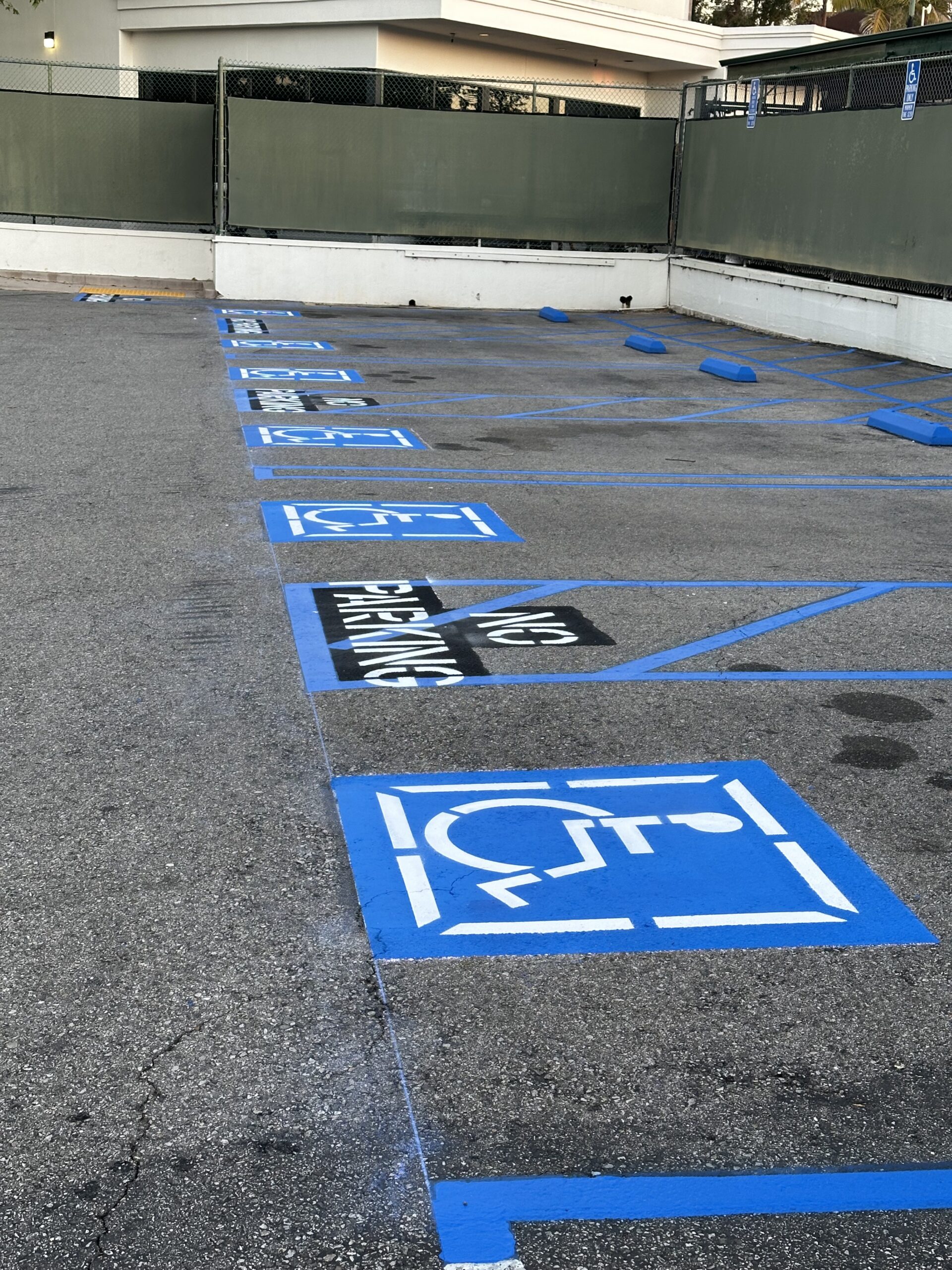
ADA Parking Compliance California — Quick Answer 2026
What Are the ADA Parking Requirements in California?
California ADA parking is governed by CBC Title 24 Chapter 11B — stricter than federal ADA 42 U.S.C. § 12101 in every dimension. Spaces must be 9 feet wide (federal minimum is 8 feet). Access aisles require “NO PARKING” in 12-inch letters. Signs must be reflectorized with 70+ square inches of reflective area and include “Minimum Fine $250” — a California-only requirement. Van-accessible spaces (1 in every 6 accessible spaces) require an 8-foot access aisle. Non-compliance triggers the Unruh Civil Rights Act (Civil Code § 51) minimum $4,000 statutory damages per violation per visit — no injury required. Call (760) 454-1606 for a free on-site ADA audit anywhere in Southern California.
California leads the nation in ADA accessibility lawsuits. The Unruh Civil Rights Act (Civil Code § 51) allows plaintiffs to collect $4,000 minimum statutory damages per violation per visit without proving actual injury or harm. A single non-compliant accessible space — wrong width, missing access aisle, illegible ISA symbol, or incorrect sign — can trigger a lawsuit the day it is discovered. Serial ADA plaintiffs’ attorneys actively survey commercial lots throughout Los Angeles, San Bernardino, Kern, and Riverside counties. Multiple violations multiply the minimum claim. Call (760) 454-1606 to schedule your free on-site audit before a plaintiff’s attorney does it for you.
Governing Codes — Federal, State & California-Specific
California ADA compliance operates on three overlapping legal layers. You must satisfy the most restrictive standard at each layer. Most California properties that believe they are ADA compliant are actually non-compliant with CBC Title 24 — which exceeds federal requirements in seven specific dimensions.
Federal ADA — 42 U.S.C. § 12101 / 2010 ADA Standards for Accessible Design
The Americans with Disabilities Act establishes the national minimum baseline for accessible parking. Title III applies to all places of public accommodation — virtually every commercial property, retail center, office building, restaurant, and service business open to the public. When a property re-stripes its parking lot, it triggers an obligation to provide accessible spaces as required by the 2010 ADA Standards per ADA.gov guidance. The federal standard is the floor — California builds above it.
Minimum accessible parking ratios. 8-foot space width (96 inches). 5-foot standard access aisle. 8-foot van-accessible aisle. 60-inch sign height. ISA symbol required. Re-striping triggers compliance obligation regardless of property age. Enforced by U.S. Department of Justice Civil Rights Division.
California Building Code — CBC Title 24 Chapter 11B
California CBC Title 24 Chapter 11B exceeds federal ADA in every measurable dimension. Key California-specific requirements: accessible spaces must be 9 feet wide (federal allows 8 feet); access aisles must be marked “NO PARKING” in 12-inch letters; vertical signs must be reflectorized with at least 70 square inches of reflective area; signs must include “Minimum Fine $250” (California-only); tow-away notices at each entrance minimum 17×22 inches with 1-inch letters are required; signs projecting into pedestrian paths require 80-inch minimum clear height. A lot built to federal-only specs fails a California CASp inspection.
9-foot minimum space width. 5-foot standard / 8-foot van-accessible access aisle. Reflectorized signage — 70+ sq in reflective area. “Minimum Fine $250” required sign language. “NO PARKING” in 12-inch letters in all access aisles. 80-inch clear height for signs in pedestrian paths. Tow-away notice at each entrance. Enforced by California Division of State Architect (DSA) and private plaintiffs under Civil Code § 51.
Unruh Civil Rights Act — California Civil Code § 51
The most consequential California-specific law is California Civil Code § 51. Unlike federal ADA which requires proof of injury, Unruh allows plaintiffs to collect $4,000 minimum statutory damages per violation per visit with no requirement to prove actual harm. Every visit to a non-compliant property is a separate cause of action. An attorney visiting a retail center three times while one space has a single defect has three separate $4,000 minimum claims — $12,000 plus attorney fees — from one space. This is why California leads the nation in ADA litigation and why compliance is not optional for any commercial property.
$4,000 minimum statutory damages per violation per visit. No proof of actual injury required. Each visit is a separate cause of action. Attorney fees awarded to prevailing plaintiff. Serial ADA plaintiffs actively surveying commercial lots throughout Los Angeles, San Bernardino, Riverside, and Kern Counties. Most dangerous ADA enforcement mechanism for California commercial property owners.
DOJ / ADA.gov — Re-Striping Triggers Compliance Obligation
Per official ADA.gov guidance, any re-striping of a parking lot triggers a compliance obligation to provide accessible spaces meeting current 2010 ADA Standards. Re-striping is considered “readily achievable” barrier removal under Title III. A property cannot re-stripe while leaving non-compliant accessible spaces — the re-stripe itself creates the obligation to correct all accessible parking simultaneously.
| Requirement | Federal ADA Min | California CBC Title 24 | Enforced By |
|---|---|---|---|
| Space width | 8 ft (96 in) | 9 ft (108 in) | DSA / Plaintiffs |
| Standard access aisle | 5 ft | 5 ft + “NO PARKING” 12-in letters | DSA / Plaintiffs |
| Van-accessible aisle | 8 ft | 8 ft + “NO PARKING” 12-in letters | DSA / Plaintiffs |
| Sign height | 60 in minimum | 60 in min + 80 in if in pedestrian path | DSA / Plaintiffs |
| Sign language | ISA symbol only | ISA + “Minimum Fine $250” required | DSA / Plaintiffs |
| Sign reflectivity | Not specified | Reflectorized — 70+ sq in | DSA / Plaintiffs |
| Tow-away notice | Not required | Required at each entrance — 17×22 in | CVC § 22658 |
| Damages | Proof of injury required | $4,000 min per visit — no injury needed | Civil Code § 51 |
Required Counts & Exact Dimensions — CBC Title 24
| Total Spaces in Lot | Min Accessible Required | Van-Accessible Required |
|---|---|---|
| 1–25 | 1 | 1 |
| 26–50 | 2 | 1 |
| 51–75 | 3 | 1 |
| 76–100 | 4 | 1 |
| 101–150 | 5 | 1 |
| 151–200 | 6 | 1 |
| 201–300 | 7 | 2 |
| 301–400 | 8 | 2 |
| 401–500 | 9 | 2 |
| 501–1,000 | 2% of total | 1 in every 6 accessible |
| 1,001+ | 20 + 1 per 100 over 1,000 | 1 in every 6 accessible |
Medical offices, outpatient facilities, and rehabilitation centers must provide 10% accessible parking of total lot capacity. A 100-space medical office lot requires 10 accessible spaces — not 4. Physical therapy and rehabilitation facilities may require up to 20%. If your property includes any healthcare use, apply the medical standard regardless of property size.
| Element | California Minimum | Notes |
|---|---|---|
| Accessible space width | 9 ft (108 in) | Outside stripe to outside stripe — exceeds 8-ft federal min |
| Accessible space length | 18 ft minimum | Full vehicle length |
| Standard access aisle | 5 ft (60 in) | “NO PARKING” in 12-in letters required |
| Van-accessible aisle | 8 ft (96 in) | “NO PARKING” in 12-in letters required |
| Van vertical clearance | 98 in (8 ft 2 in) | Critical in structured / covered parking |
| ISA pavement symbol | 36 in × 36 in | Blue background, white symbol |
| Sign height (bottom of sign) | 60 in above finish floor | 80 in if sign projects into pedestrian path |
| Surface slope | Max 2.08% (1:48) any direction | Most common hidden violation — requires survey to detect |
| Accessible route width | 36 in minimum | From parking to building entrance — no curbs, no stairs |
Most Common ADA Violations in California
- Space width 8 feet instead of California required 9 feet — built to federal minimum only
- Missing “NO PARKING” text in access aisle — required in 12-inch letters per CBC
- ISA pavement symbol faded below visible threshold — active violation even if dimensions correct
- Sign missing “Minimum Fine $250” language — California-specific, absent from federal ADA
- Sign not reflectorized or below 70 square inches of reflective area
- Surface slope exceeding 2.08% — most frequently missed, most expensive to correct
- Wheel stop blocking access aisle or accessible route — direct violation per CBC 11B-502
- No accessible route from parking to building entrance — each gap is a separate violation
- Medical facility using standard ratio instead of 10% minimum
- Accessible space count not updated when lot was expanded or re-configured

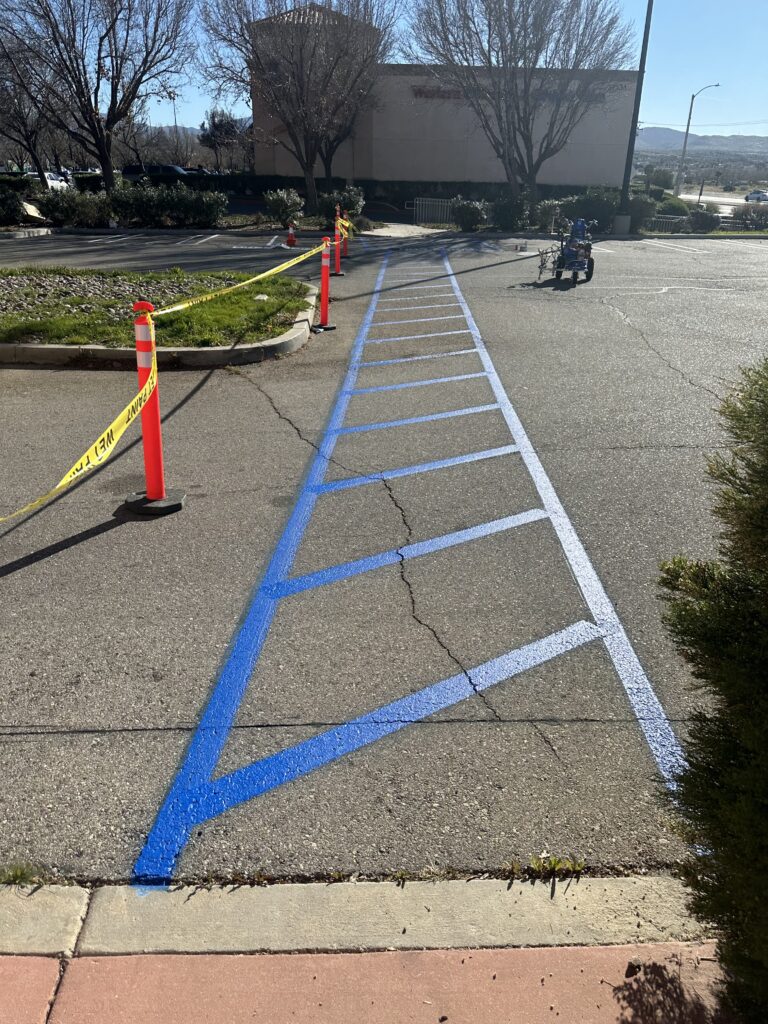
ADA compliant accessible parking striping · Southern California · Bowman Line Striping Inc · CA License #1138257
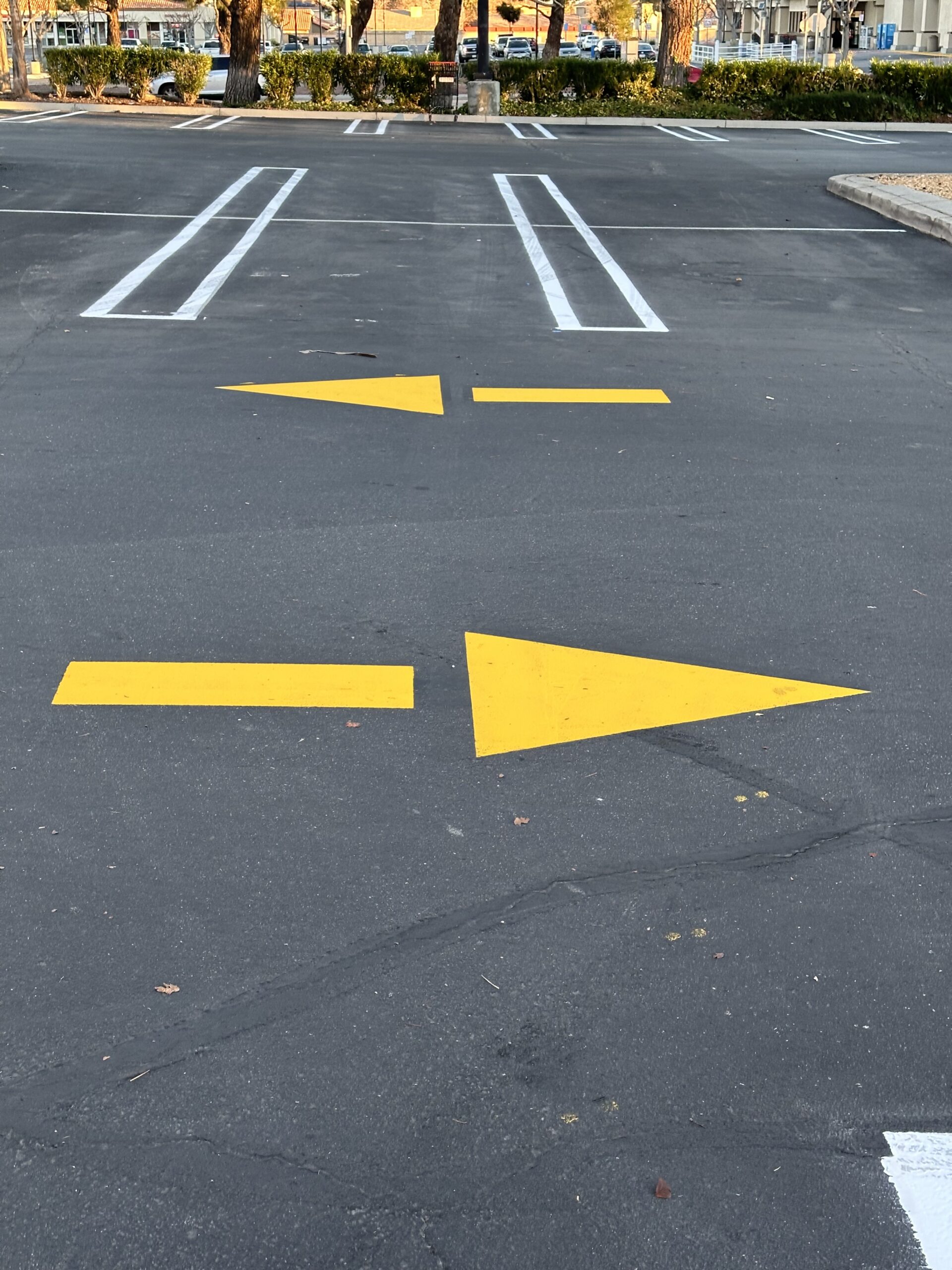
Professional ADA compliant parking lot striping · Southern California · Bowman Line Striping Inc · CA License #1138257
ADA Parking Painting & Compliance Services
Complete ADA accessible parking painting and compliance from audit through installation — measured precisely, documented thoroughly, CBC Title 24 certified. Free on-site audit with every estimate statewide.
Free On-Site ADA Audit
On-site measurement of every accessible space against CBC Title 24. Written report identifying every violation with correction scope and cost. No obligation — call to schedule anywhere in Southern California.
Request free audit →ADA Handicap Parking Painting
Precision 9-foot space width, ISA blue/white symbol, access aisle diagonal striping with 12-inch “NO PARKING” text. ADA handicap parking painting includes laser-guided layout. CBC Title 24 Chapter 11B dimensions verified before any paint is applied.
Full striping services →Van-Accessible Designation
8-foot access aisle, “VAN ACCESSIBLE” pavement text, combined ISA + van symbol, correct sign installation. One in every six accessible spaces must meet van standard — the most commonly miscounted requirement in California lots.
Van-accessible details →ADA Sign Installation
Reflectorized signs with 70+ square inch reflective area, ISA symbol, “Minimum Fine $250” language, mounted at 60-inch minimum height. Van-accessible supplemental sign. Post anchored in asphalt or concrete.
Sign installation →Accessible Route Marking
Continuous 36-inch minimum accessible route from every accessible space to building entrance. Truncated dome detectable warnings at curb ramps. Crosswalk marking with pedestrian priority. No curbs or stairs along route.
Pavement markings →ADA + EV Charging
CALGreen CBC 11B-228.3.2 requires accessible EV charging spaces independent of ADA parking counts. Accessible EV spaces require 9-ft width, aisle preserved around equipment, combined ISA + EV stenciling. Additive to — not a substitute for — required accessible parking.
EV charging striping →Tow-Away Entrance Notices
California Vehicle Code § 22658 requires tow-away notice signs at every entrance — minimum 17×22 inches with 1-inch letters. Absent signs void tow enforcement authority. Frequently overlooked in compliance audits.
Sign installation →Wheel Stop Compliance
Wheel stops blocking any portion of the access aisle or accessible route are a direct CBC violation. We audit stop placement against CBC 11B-502.7.2 requirements and reposition as needed.
Wheel stop services →Space count vs total lot · Space width (9-ft CBC vs 8-ft federal) · Access aisle width and “NO PARKING” markings · Van-accessible count (1 in 6) · ISA symbol visibility · Sign height and reflectivity · Sign language including “Minimum Fine $250” · Surface slope (max 2.08%) · Accessible route continuity · Wheel stop placement · Tow-away entrance notices · EV accessible charging if applicable. Written report provided at no cost. Call (760) 454-1606.
ADA Compliance Pricing — 2026
| Service | Unit | Low | High | Notes |
|---|---|---|---|---|
| Free on-site ADA audit | Per property | $0 | $0 | Written report — no obligation |
| Standard accessible space — full paint | Per space | $60 | $110 | 9-ft width, ISA symbol, aisle, CBC Title 24 |
| Van-accessible space — full paint | Per space | $85 | $150 | ISA + van designation, 8-ft aisle markings |
| Access aisle re-mark only | Per aisle | $35 | $75 | Diagonal striping + “NO PARKING” 12-in text |
| ISA symbol refresh only | Per space | $35 | $65 | When space lines are correct — symbol only |
| ADA sign — supply and install | Per sign | $85 | $175 | Reflectorized, “Min Fine $250”, post anchored |
| Van-accessible supplemental sign | Per sign | $45 | $95 | Mounted below primary ADA sign |
| Tow-away entrance notice | Per sign | $65 | $125 | CVC § 22658 compliant — 17×22-in minimum |
| Accessible route striping | Per linear ft | $2 | $5 | Path from parking to building entrance |
| Full ADA correction — small lot (under 50 spaces) | Per project | $350 | $900 | All spaces, aisles, signs, route marking |
| Full ADA correction — mid lot (50–150 spaces) | Per project | $750 | $2,200 | Full CBC Title 24 compliance package |
Full ADA correction on a 50-space lot: $350–$900. One Unruh Civil Rights Act claim for one non-compliant space on one visit: $4,000 minimum plus attorney fees. Most California ADA cases settle for $15,000–$50,000 even for small lots. The correction is never the expensive option.
ADA Compliance FAQ — California 2026
Federal ADA (42 U.S.C. § 12101) sets the national minimum — 8-foot space width, 5-foot standard access aisle, 60-inch sign height. California CBC Title 24 Chapter 11B exceeds federal in every dimension: 9-foot space width, “NO PARKING” in 12-inch letters in all access aisles, reflectorized signs with 70+ square inches reflective area, “Minimum Fine $250” sign language (California-only), and tow-away notices at every entrance. A lot built to federal specs fails a California CASp inspection. The stricter California standard always applies.
CBC Title 24 requires: 1–25 total spaces = 1; 26–50 = 2; 51–75 = 3; 76–100 = 4; 101–150 = 5; 151–200 = 6; 201–300 = 7; 301–400 = 8; 401–500 = 9; 501–1,000 = 2% of total. One in every six accessible spaces must be van-accessible with an 8-foot access aisle. Medical facilities must provide 10% accessible of total lot capacity. Count every space the lot serves — customer, employee, visitor, and compact — when calculating the required number.
California Civil Code § 51 (Unruh Civil Rights Act) allows any person with a disability to collect $4,000 minimum statutory damages per violation per visit with no requirement to prove actual harm. Every visit to a non-compliant accessible space is a separate cause of action. Three visits to a property with one non-compliant space = three separate $4,000 minimum claims = $12,000 minimum plus attorney fees. Serial ADA plaintiffs’ attorneys actively survey commercial lots throughout Southern California specifically looking for these violations.
Yes — per ADA.gov, re-striping a parking lot triggers a compliance obligation to provide accessible spaces meeting current 2010 ADA Standards. Re-striping is classified as “readily achievable” barrier removal under Title III. A property cannot re-stripe while leaving non-compliant accessible spaces. A contractor who re-stripes a lot without correcting ADA defects creates documented evidence that the owner had opportunity to achieve compliance and chose not to — significantly worsening any subsequent litigation exposure.
California CBC Title 24 requires: (1) ISA symbol on every sign; (2) Reflectorized with at least 70 square inches of reflective area; (3) “Minimum Fine $250” — California-only, not in federal ADA; (4) Bottom of sign at 60 inches minimum above finish floor; (5) 80 inches clear height if sign projects into pedestrian path; (6) Van-accessible supplemental sign below ISA sign; (7) Tow-away notices at each lot entrance — 17×22 inches minimum with 1-inch letters per California Vehicle Code § 22658.
In California, accessible parking spaces must be 9 feet wide minimum per CBC Title 24 Chapter 11B — measured from outside stripe to outside stripe. This exceeds the federal ADA minimum of 8 feet. Spaces measuring 8 feet 11 inches fail California compliance even though they satisfy federal ADA. Van-accessible spaces are also 9 feet wide with an adjacent 8-foot access aisle. Most parking lots built to older standards or federal-only specs are out of California compliance on this dimension alone.
Yes — ADA compliance is continuous, not just at time of installation. Faded ISA symbols, illegible “NO PARKING” aisle text, and deteriorated diagonal striping all constitute active violations. The ADA requires accessible parking be maintained in accessible condition — fading paint breaks that obligation. California courts have consistently found markings faded below clear visibility to be non-compliant regardless of original installation quality. Re-stripe ADA spaces on the same maintenance cycle as regular spaces — typically every 12–18 months in Southern California.
A Certified Access Specialist (CASp) inspection evaluates your property against current ADA and CBC Title 24. Properties with a current CASp report gain critical legal protections: courts must grant a 90-day stay of ADA litigation to allow correction, and early settlement conference rights apply. Properties without CASp reports do not get this protection. Scheduling a CASp inspection before receiving a demand letter costs a fraction of what litigation costs — and gives you statutory protection to correct issues before a lawsuit proceeds.
Standard accessible space full repaint $60–$110. Van-accessible space $85–$150. ADA sign supply and install $85–$175. Access aisle re-mark $35–$75. Tow-away entrance notice $65–$125. Full lot ADA correction under 50 spaces typically $350–$900 covering all spaces, aisles, signs, and route marking. Mid-size lots 50–150 spaces $750–$2,200. Free on-site audit provided at no cost — call (760) 454-1606 or (818) 930-5859. Compare these numbers to the Unruh Civil Rights Act minimum $4,000 per violation per visit.
Yes — property age does not exempt from ADA compliance. The ADA requires all commercial properties open to the public to remove accessibility barriers when “readily achievable” — and re-striping is explicitly classified as readily achievable. Properties built before 1990 are not grandfathered for existing barrier removal. Any time a property undergoes renovation, improvement, or re-striping, it must bring all accessible parking to current CBC Title 24 standards as part of that work. Call (760) 454-1606 for a free audit — we assess exactly what your property requires.
ADA parking painting — also called ADA handicap parking painting, accessible space marking, or ADA striping — includes everything applied to the pavement to create a compliant accessible parking space. A complete ADA parking painting job covers: the 9-foot wide space boundary lines in blue or white paint, the International Symbol of Accessibility (ISA) — the wheelchair symbol in blue and white — centered in the space, diagonal access aisle striping with “NO PARKING” in 12-inch letters, and for van-accessible spaces, additional aisle width marking and “VAN ACCESSIBLE” pavement text. ADA parking painting is different from regular parking lot striping because it requires precise dimensional measurement, correct paint colors, and specific symbol sizing. Call (760) 454-1606 for a free ADA parking painting estimate anywhere in Southern California.
Find Us on Google — Two Locations
Veteran-owned · CA License #1138257 · Serving all of Southern California from Ridgecrest and Van Nuys
Van Nuys — LA Office
Serving Los Angeles, San Fernando Valley, Ventura County & surrounding areas · (818) 930-5859
View on Google MapsRidgecrest — Main Office
Serving Ridgecrest, Victorville, High Desert, Bakersfield & Inland Empire · (760) 454-1606
View on Google MapsFree ADA Compliance Audit — No Obligation
CBC Title 24 certified. Written violation report with correction scope. Statewide service — Los Angeles to Ridgecrest. Same-day estimates. Veteran-owned CA License #1138257.
Request Free Written Estimate →Veteran-Owned · CA Contractor License #1138257 · BBB Accredited · Mon–Sun 8am–7pm